
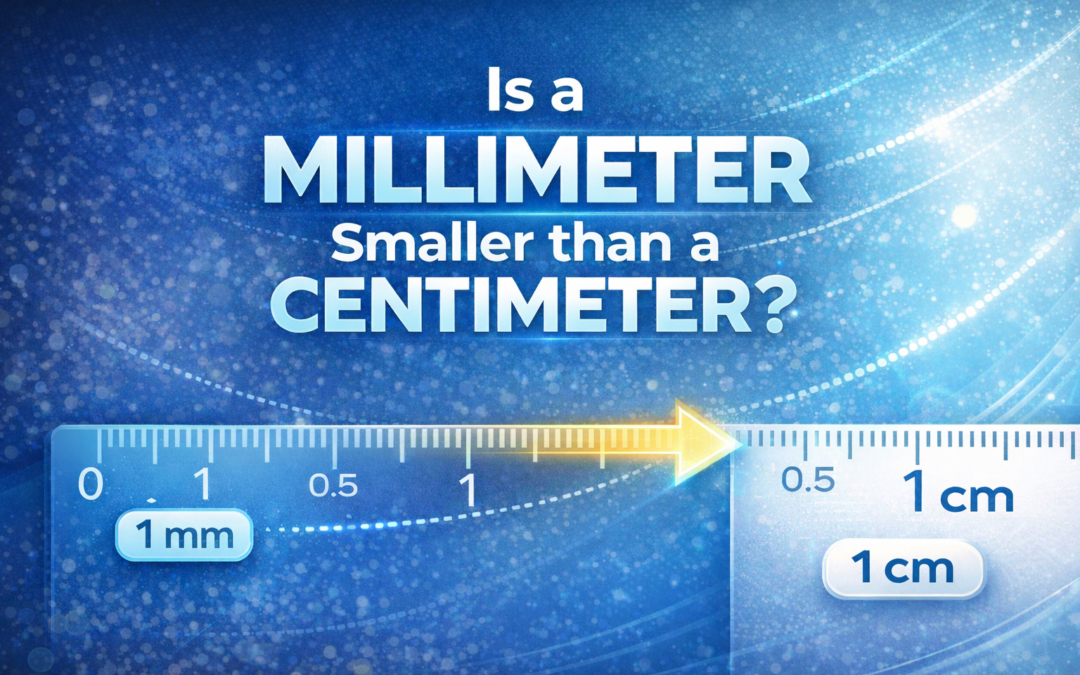
You see millimeters and centimeters on rulers, product specs, and DIY plans, but the difference can still feel confusing when you need a fast, accurate answer. If you are asking, “is a millimeter smaller than a centimeter?” the answer is yes, and the reason comes down to a simple base-10 relationship in the metric system.
Once you understand that relationship, you can convert instantly, read any metric ruler correctly, and avoid costly measurement mistakes in school, home projects, and work. Read for more update on this topic!
The direct answer and the one fact to remember
Yes, a millimeter is smaller than a centimeter, and the simplest way to remember it is that 10 millimeters fit into 1 centimeter. When you move from centimeters to millimeters, you are moving to a smaller unit, so you get more units for the same length. That is why 3 centimeters becomes 30 millimeters, not 3 millimeters.
A quick mental picture that makes it stick
On a standard metric ruler, the longer numbered marks represent centimeters, while the tiny evenly spaced marks between them represent millimeters. If you count the small marks from one centimeter line to the next, you will count ten millimeters in that single centimeter span. This visual check gives you a built-in error trap, because if you ever get a conversion that breaks the “ten per one” pattern, you know something went wrong.
Metric unit sizes explained in plain language
The metric system works in powers of ten, which means each step up is ten times larger and each step down is ten times smaller. A centimeter is a larger step than a millimeter, so a centimeter covers more distance with fewer units. That is why centimeters are handy for everyday object sizes, while millimeters help when you need finer precision.
Where millimeters sit in the measurement ladder
In the common metric ladder, millimeter sits below centimeter, and centimeter sits below meter, so the relationships stay consistent across the whole system. You can write it as 1 meter equals 100 centimeters, and 1 centimeter equals 10 millimeters, which also means 1 meter equals 1,000 millimeters. Once you know those three relationships, you can convert most metric lengths without a calculator.
Converting centimeters to millimeters without mistakes
To convert centimeters to millimeters, you multiply by 10 because you are moving from a bigger unit to a smaller unit. Multiplying makes sense because the number of units must increase to represent the same length in a smaller measurement. For example, 6.5 cm becomes 65 mm, and 0.2 cm becomes 2 mm.
A fast method you can use in your head
You can convert by shifting one place to the right in base-10 style, which is the same as multiplying by 10. If the value has a decimal, you keep the digits in the same order and move the decimal one place to the right, so 1.7 cm becomes 17 mm. This simple pattern helps you stay accurate even when you are measuring quickly under pressure.
Converting millimeters to centimeters the easy way
To convert millimeters to centimeters, you divide by 10 because you are moving from a smaller unit to a larger unit. Dividing makes sense because fewer centimeters are needed to represent the same length when the unit is larger. For example, 50 mm becomes 5 cm, and 8 mm becomes 0.8 cm.
The mistake that causes most conversion errors
Many people accidentally multiply when they should divide, especially when they are rushing or copying steps from memory. A reliable check is to ask yourself whether the number should get bigger or smaller, because converting a small unit into a larger unit must reduce the number. If your conversion turns 12 mm into 120 cm, the size logic tells you instantly that the result cannot be correct.
How to read a metric ruler like a pro
A metric ruler is designed to make the centimeter to millimeter relationship obvious, but you still need a consistent method. You should align the object with the zero mark, then read the last full centimeter line, and finally count the additional millimeter ticks beyond that line. This method prevents you from guessing the length based on where the object “seems” to end.
A practical example you can copy for real measurements
If an object reaches the 4 cm line and then extends three tiny ticks past it, the length is 4.3 cm, which equals 43 mm. If the object ends exactly on a long line, you can read centimeters directly without counting millimeters, but you should still confirm the alignment at zero. This approach keeps your measurements consistent whether you are measuring paper, hardware, or craft materials.
Why millimeters matter in real-life situations
Millimeters matter because they give you fine control, and small differences can cause big results in tight tolerances. In woodworking, 2 mm can change how parts fit, and in printing, a few millimeters can shift a layout enough to look unprofessional. When accuracy matters, millimeters reduce rounding and help you communicate measurements clearly.
When centimeters are the better choice
Centimeters are often better when the object is large enough that millimeter detail does not change the outcome.
If you are measuring the height of a plant, the width of a notebook, or the length of a small shelf, centimeters keep the number easy to read and easy to say. You can still switch to millimeters when you need detail, but centimeters keep everyday measurements clean and practical.
Metric vs US customary units in a measurement decision
In the United States, you often see inches and feet used for home projects, but many products and technical documents still use millimeters.
A key statistic you can rely on is that 1 inch equals 25.4 millimeters, which is exact and widely used in standards and manufacturing. If you are comparing parts from different sources, converting to one unit before you decide prevents compatibility issues.
A conversion shortcut that saves time
If you already have millimeters and you want inches, you can divide by 25.4 to get a precise inch value. When you want a fast estimate, you can remember that 25 mm is just under 1 inch, which helps you sanity-check whether the size “feels” right. When you need accuracy for ordering or fitting parts, use a precise conversion method like convert millimeters to inches inside your measurement workflow so you do not mix units mid-task.
Decimal values and precision you can trust
Decimal millimeters and centimeters are common in product specs, engineering drawings, and science lab work. You should treat decimals as a normal part of metric measurement, because the system is built to handle them smoothly without fractions. Precision improves when you keep the unit consistent and avoid rounding until the final step.
How to choose the right level of rounding
Rounding too early can stack errors, especially when you add multiple measurements together. If you are cutting material, measuring gaps, or setting a distance between holes, keep one extra decimal place during planning and round only when you execute the final cut or placement. If you want a deeper explanation of unit size relationships that supports better rounding habits, you can use what fraction of a meter is a millimeter as a quick reference point while you work.
Common misconceptions that lead to wrong answers
A common misconception is thinking that “centi” sounds smaller than “milli,” but the prefixes actually tell you the opposite. Milli means one-thousandth of a meter, while centi means one-hundredth of a meter, so a millimeter is smaller than a centimeter by a factor of ten. If you anchor your thinking to the meter, the whole system becomes easier to check.
A simple truth test you can apply anytime
When you are uncertain, pick an easy reference length like 1 centimeter and translate it into millimeters in your head. If you can say “one centimeter equals ten millimeters” without hesitation, you can use that as your truth test for every related question. If your final answer breaks that relationship, you know you should redo the conversion before you trust it.
Quick examples you can use for school, DIY, and shopping
Examples make the difference feel real, so you can apply the concept in seconds. A phone that is 7.5 cm wide is 75 mm wide, and a screw that is 30 mm long is 3 cm long, which helps you visualize the same length in two formats. These examples also help you interpret spec sheets that switch between units depending on region or industry.
A conversion workflow that avoids errors
Start by choosing one unit as your “working unit,” then convert everything into that unit before you compare or calculate. If you are working with small dimensions, use millimeters first, and if you are working with larger objects, use centimeters or meters first, then convert down only when needed. For a closely related explanation that reinforces the same idea from the opposite angle, you can read is a centimeter bigger than a millimeter and use its examples to double-check your own thinking.
When unit choice affects clarity in communication
The best unit is not only correct, it is also easy for the other person to understand. If you are talking to a contractor, a teacher, or a friend, saying “50 mm” may communicate better than “5 cm” when the job involves small, precise spacing. If the task is general sizing, “5 cm” may communicate faster because the number feels simpler.
How to write measurements clearly every time
You should always include the unit symbol, and you should avoid switching units in the same sentence unless you are intentionally comparing them. If you use millimeters, write mm, and if you use centimeters, write cm, then keep the rest of the data consistent across your notes, labels, and messages. This habit prevents misreads that can happen when people assume an unlabeled number uses the unit they are used to seeing.
Conclusion
A millimeter is smaller than a centimeter because 10 millimeters make 1 centimeter, and that base-10 structure is the core reason metric conversions can be fast and reliable. When you multiply by 10 you move from centimeters to millimeters, and when you divide by 10 you move from millimeters to centimeters, so your result should always match the size logic of bigger units producing smaller numbers.
If you read the ruler from zero, keep one unit consistent while you calculate, and use the exact benchmark that 1 inch equals 25.4 mm when you compare against US customary sizes, you will measure with confidence and avoid the most common conversion mistakes.