
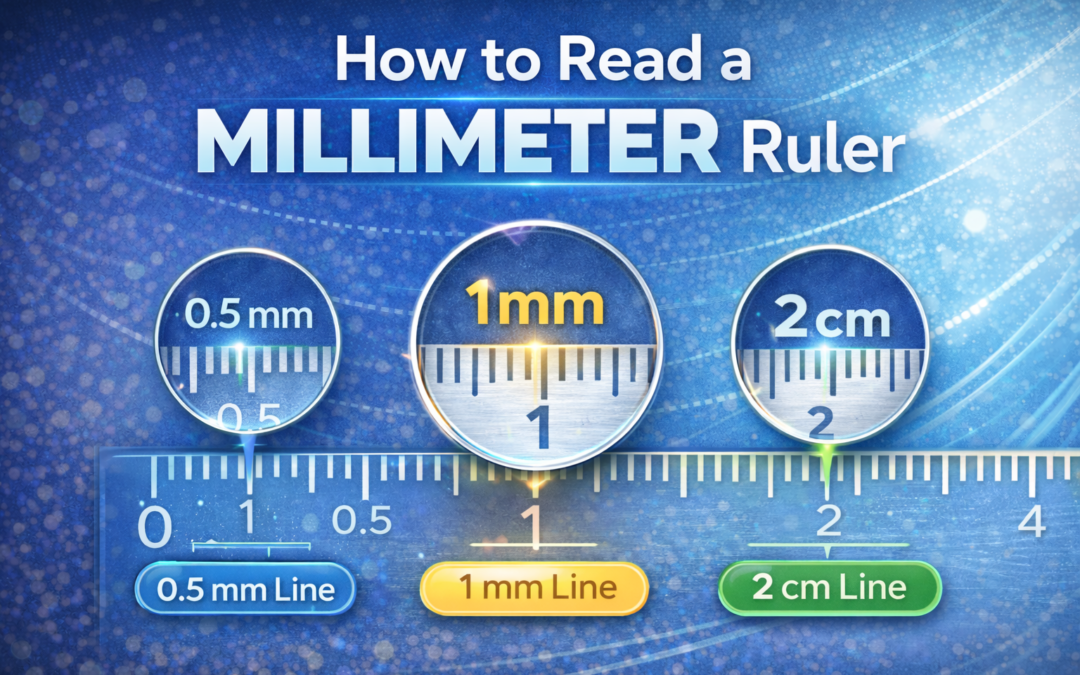
Reading a millimeter ruler accurately gives you control over precise measurements in school projects, home improvement tasks, sewing, and technical work. When you understand how each small mark represents one millimeter and how those marks relate to centimeters, you eliminate guesswork and avoid costly errors.
In this guide, you will learn how to read a millimeter ruler confidently, apply metric conversions correctly, and measure objects with precision that matches professional standards.
Understanding What a Millimeter Really Is
A millimeter, written as mm, is one of the smallest standard units of length in the metric system. You use it to measure very small distances, especially when accuracy matters in fields like engineering, carpentry, or design. Because the metric system is based on powers of ten, one millimeter equals one thousandth of a meter.
When you look at a metric ruler, each tiny line between numbered centimeter marks represents one millimeter. Ten millimeters equal one centimeter, which means the centimeter mark groups those smaller divisions into an easy-to-read unit. This base-10 structure makes the metric system more logical and easier to calculate than fractional-inch systems.
In the United States, many industries still use inches, but science, healthcare, and manufacturing rely heavily on millimeters. For example, 1 inch equals 25.4 millimeters, which highlights how precise metric measurements can be. Once you understand this relationship, reading a millimeter ruler becomes straightforward and consistent.
Identifying the Parts of a Metric Ruler
Before you measure anything, you need to recognize the structure of a metric ruler. A standard school ruler usually measures 30 centimeters, and each centimeter is divided into ten equal millimeter sections. The longer lines with numbers represent centimeters, while the shorter lines between them represent millimeters.
You will often see a slightly longer line halfway between two centimeter marks, which indicates five millimeters or 0.5 centimeters. These visual cues help you estimate measurements quickly without having to count every small tick. When you train your eye to distinguish long, medium, and short lines, you reduce mistakes.
Many rulers also include an inch scale on the opposite side, but you should focus only on the metric side when learning how to read a millimeter ruler. Mixing scales can lead to confusion and inaccurate results. Always confirm you are using the side labeled with “cm” and “mm” before measuring.
Step-by-Step Process to Read a Millimeter Ruler
To measure correctly, place the object so its edge aligns exactly with the zero mark on the ruler. Do not start at the physical edge of the ruler unless it perfectly matches zero, because worn edges can cause errors. Proper alignment ensures your reading begins from the correct reference point.
Next, locate the last full centimeter mark that the object reaches. Count the number of complete centimeters first, because that forms the base of your measurement. After that, count the number of millimeter lines beyond that centimeter mark until you reach the object’s end.
Finally, combine the two values into a complete measurement. For example, if an object reaches 7 centimeters and 3 additional millimeter marks, the measurement is 7.3 centimeters or 73 millimeters. This structured method prevents confusion and improves accuracy in real-world tasks.
Converting Between Millimeters and Centimeters
Understanding conversion helps you double-check your measurements quickly. Since 10 millimeters equal 1 centimeter, you can convert millimeters to centimeters by dividing by 10. For example, 45 millimeters equals 4.5 centimeters.
If you need to convert centimeters to millimeters, multiply by 10. A measurement of 6.2 centimeters equals 62 millimeters, which is especially useful when working with technical specifications. The decimal point simply shifts one place because the metric system follows a base-10 structure.
When you want a deeper explanation of the metric hierarchy, reading about what fraction of a meter is a millimeter at what fraction of a meter is a millimeter clarifies how millimeters fit within the broader metric ladder. This knowledge strengthens your ability to convert between meters, centimeters, and millimeters confidently.
Converting Millimeters to Inches Accurately
In the United States, you often need to convert millimeters to inches for compatibility with construction materials or product dimensions. The exact conversion factor is 25.4 millimeters per inch, which means you divide millimeters by 25.4 to get inches. For example, 50 millimeters equals approximately 1.97 inches.
Manual conversion requires careful calculation to avoid rounding errors. If you want fast and precise results when you convert millimeters to inches, you can use a reliable tool like convert millimeters to inches, which applies the correct formula instantly. Using accurate conversions prevents mistakes in high-precision environments such as manufacturing or design.
Understanding the mathematical relationship also builds confidence when you measure without a calculator. When you know the conversion factor and practice applying it, you reduce dependency on guesswork. Precision in unit conversion directly supports accurate ruler readings.
Avoiding Common Measurement Mistakes
Many people make simple mistakes that distort measurements. Starting from the edge instead of the zero mark shifts the reading and produces inaccurate results. Always verify that the zero line is intact and visible before placing your object.
Another frequent error involves counting lines instead of spaces incorrectly. Each small space between millimeter marks represents one millimeter, so careful counting matters when measuring small objects. Rushing the process can result in off-by-one errors that compound in larger projects.
If you struggle with comparing units, understanding the difference between millimeter and micrometer at millimeter vs micrometer helps you avoid confusing similar metric terms. Knowing the scale difference between these units ensures that you apply the correct measurement in scientific or technical tasks.
Reading Measurements Longer Than One Centimeter
When measuring objects longer than one centimeter, focus on breaking the reading into two parts. First, identify the number of full centimeters reached. Then count the remaining millimeters beyond the last centimeter mark.
For example, if an object extends to 12 centimeters and 8 millimeters, the total measurement equals 12.8 centimeters or 128 millimeters. This two-step approach keeps your measurement organized and easy to communicate.
Professionals often express measurements in millimeters for clarity, especially in engineering drawings. Writing 128 millimeters instead of 12.8 centimeters can eliminate decimal confusion in technical documents. Clear communication of measurements improves collaboration and reduces costly misunderstandings.
Using Visual Estimation for Faster Reading
With practice, you can estimate millimeters without counting every line. The midpoint between centimeter marks represents five millimeters, so you can visually judge whether a measurement is slightly above or below that halfway mark. This skill speeds up your work without sacrificing accuracy.
However, estimation should never replace careful counting when precision matters. In fields like healthcare, a difference of one millimeter can affect outcomes significantly. The World Health Organization often references millimeter-level precision in clinical measurements, which highlights how small units matter.
You improve estimation by repeatedly measuring everyday objects such as coins, paper thickness, or small hardware parts. Repetition builds familiarity and strengthens your confidence in reading a millimeter ruler quickly and accurately.
Why the Metric System Makes Measurement Easier
The metric system simplifies decision-making because each unit increases or decreases by powers of ten. Unlike fractional inches, you do not need to interpret complex divisions like 1/16 or 3/32. This logical structure makes learning how to read a millimeter ruler far more intuitive.
Each step on the metric ladder multiplies or divides by ten, whether you move from millimeters to centimeters or centimeters to meters. This uniform pattern reduces mental strain and calculation errors. As a result, students and professionals often prefer metric measurements for technical accuracy.
In fact, over 95 percent of the world’s population uses the metric system officially, which demonstrates its global reliability and efficiency. When you master millimeter readings, you align your skills with international measurement standards.
Practical Applications in Everyday Life
You use millimeter measurements more often than you realize. Smartphone thickness, mechanical parts, and medical instruments are commonly measured in millimeters for precision. Even clothing alterations often rely on millimeter adjustments for a perfect fit.
In home improvement projects, accurate millimeter readings prevent alignment issues and material waste. When installing cabinets or fitting tiles, a few millimeters can determine whether components fit seamlessly. Precision reduces rework and saves time and money.
Educational settings also emphasize millimeter accuracy because it strengthens mathematical reasoning. When students practice reading rulers, they build foundational skills that support science and engineering careers. Mastering this simple tool creates long-term benefits.
Conclusion
Learning how to read a millimeter ruler correctly empowers you to measure with confidence and precision in any environment. By aligning your object at zero, counting full centimeters first, and then adding remaining millimeters, you apply a clear and reliable process. Understanding conversions between millimeters, centimeters, and inches strengthens your accuracy and prevents costly errors.
As you practice reading metric rulers, your speed and confidence increase naturally. You begin to recognize visual patterns, estimate distances effectively, and communicate measurements clearly. When precision matters, your ability to read millimeters accurately becomes a powerful and practical skill that supports both everyday tasks and high-performance technical work.