
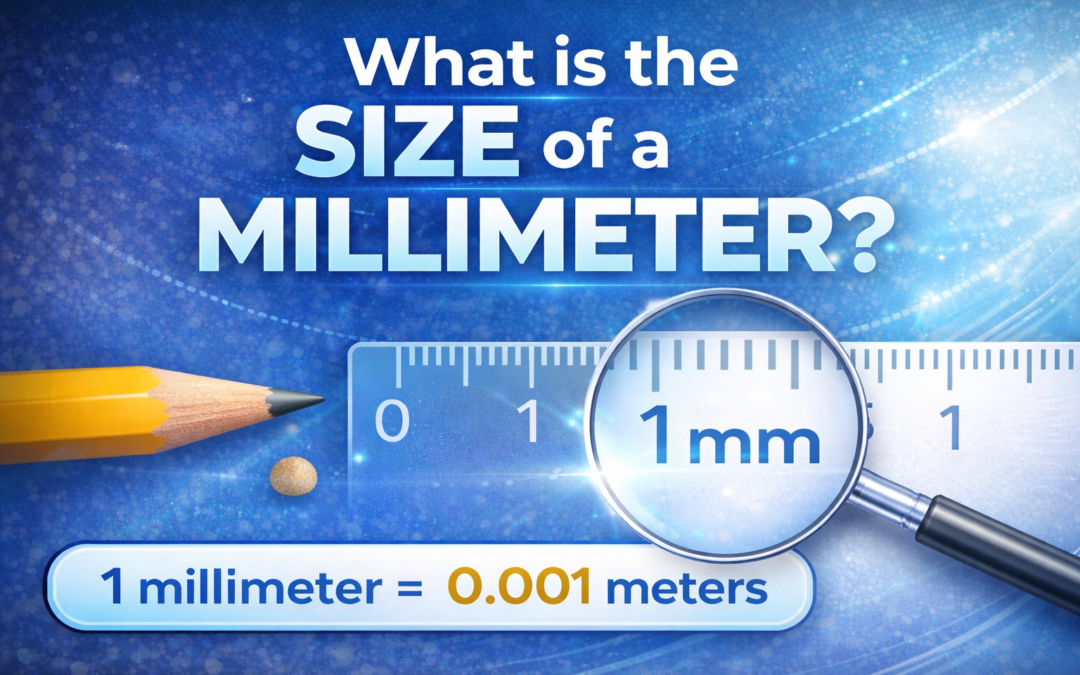
What is the size of a millimeter, and how small is it in practical terms? You encounter millimeters in electronics, jewelry, medicine, and construction, yet many people struggle to picture the unit clearly.
In this guide, you will learn the exact definition, real-world comparisons, and accurate conversions so you can measure confidently and understand why this tiny unit plays such a powerful role in modern life.
The Exact Definition of a Millimeter
A millimeter, abbreviated as mm, is a unit of length in the metric system equal to one-thousandth of a meter. This means that 1,000 millimeters make one meter, and 10 millimeters make one centimeter. When you ask what the size of a millimeter is, you are asking about one of the smallest standard divisions used in everyday measurement.
Because the metric system uses a base-ten system, conversions remain simple and predictable. You divide or multiply by ten, one hundred, or one thousand, depending on the unit change required. This structure eliminates the complex fractions found in the imperial system and supports precise scientific calculations.
The millimeter is part of the International System of Units, known as SI. Since the meter itself is defined using the speed of light, the millimeter inherits that scientific precision. That global consistency ensures engineers, doctors, and researchers measure using the same standard worldwide.
Visualizing the Size of a Millimeter
Understanding numbers alone does not fully answer what is the size of a millimeter, so you need practical comparisons. A single grain of table sugar measures about one millimeter across, which gives you a relatable visual reference. The width of a grain of rice is also close to one millimeter, helping you imagine its scale.
A typical sheet of printer paper measures roughly 0.1 millimeters thick. When you stack ten sheets together, you create a stack about 1 millimeter high. This stacking method gives you a simple, reliable way to visualize the unit without a ruler.
A human hair averages about 0.07 millimeters in thickness. That means more than fourteen strands placed side by side equal roughly one millimeter. These comparisons reveal just how small this unit truly is.
Millimeters on a Ruler
On a standard metric ruler, each centimeter is divided into ten equal segments. Each of those small tick marks represents exactly one millimeter. When you look closely between two numbered centimeter marks, you will see ten evenly spaced lines.
This design allows you to measure small objects quickly and accurately. If an object extends five small ticks beyond a centimeter mark, it measures 15 millimeters in total. The clarity of this layout makes millimeters practical for daily use.
Because the metric system is decimal-based, you can easily convert 25 millimeters into 2.5 centimeters. That straightforward structure reduces measurement errors and improves consistency. It also makes teaching and learning measurements significantly easier.
How a Millimeter Compares to a Centimeter and Meter
To fully grasp what is the size of a millimeter, you must compare it to larger metric units. One centimeter equals 10 millimeters, which means a millimeter is one-tenth of a centimeter. One meter equals 1,000 millimeters, making a millimeter one-thousandth of a meter.
These relationships remain consistent across all metric units because of the base-ten system. If you want a deeper explanation of how the units relate mathematically, you can read about what fraction of a meter is a millimeter to see the exact proportional breakdown. Understanding this fraction strengthens your mental model of metric scaling.
When you move to larger distances like kilometers, the difference becomes dramatic. One kilometer contains one million millimeters. This scalability explains why the metric system supports both microscopic and large-scale measurement seamlessly.
What Is the Size of a Millimeter in Inches
In the United States, you often encounter inches instead of millimeters. One inch equals exactly 25.4 millimeters, which means one millimeter equals approximately 0.03937 inches. This small decimal value highlights how tiny a millimeter truly is compared to an inch.
If you need to convert millimeters to inches accurately for technical work, you multiply the millimeter value by 0.03937 or divide by 25.4. Many professionals use digital tools to convert millimeters to inches because precision matters in construction and manufacturing. Even a one-millimeter difference can affect fit, alignment, or safety.
For example, 10 millimeters equals about 0.39 inches, which is slightly less than half an inch. That comparison helps you build intuition when switching between systems. Once you memorize the 25.4 relationship, conversions become second nature.
Conversion Factors You Should Know
When answering what is the size of a millimeter, conversion accuracy becomes essential. The exact conversion factor from millimeters to inches is 1 millimeter equals 0.03937 inches. Conversely, 1 inch equals 25.4 millimeters.
If you want a deeper mathematical breakdown, you can review what is the conversion factor from millimeters to inches to understand why 25.4 defines the relationship. This factor is not an estimate but an exact international standard. Knowing this prevents rounding errors in precise calculations.
In professional settings, small rounding differences can accumulate and create structural issues. Engineers and machinists therefore rely on exact values rather than approximations. Accuracy at the millimeter level directly affects performance and reliability.
Why Millimeters Matter in Medicine and Engineering
Millimeters play a critical role in medical procedures and diagnostics. Surgeons measure incision lengths and tumor sizes in millimeters to maintain patient safety. Radiology reports frequently describe abnormalities in millimeter increments.
In engineering, tolerances often measure 0.01 millimeters or less. Automotive engines, aerospace components, and electronic devices depend on these tight specifications. Without millimeter-level precision, mechanical systems would fail or perform inefficiently.
Digital calipers commonly measure down to 0.01 millimeters, demonstrating how refined modern tools have become. That level of accuracy ensures components align exactly as designed. Millimeters therefore support both innovation and safety.
Real-World Objects That Measure a Few Millimeters
Many objects around you measure only a few millimeters in size. The thickness of a U.S. dime is about 1.35 millimeters, giving you a tangible physical example. That coin provides a quick way to approximate small distances visually.
Small insects often measure between 3 and 10 millimeters long. Watch components, springs, and smartphone internal parts frequently fall within this range. These examples highlight how modern design depends on compact dimensions.
Even rainfall in meteorology is measured in millimeters. A rainfall report of 10 millimeters indicates a measurable and meaningful amount of precipitation. This unit therefore influences weather analysis and infrastructure planning.
Common Measurement Mistakes to Avoid
Some people confuse the term mil with millimeter, which can create serious errors. In the United States, a mil typically means one-thousandth of an inch rather than one millimeter. Mixing these units can result in costly manufacturing mistakes.
Another common mistake involves rounding conversions too early in calculations. If you round before completing your math, you introduce cumulative inaccuracies. Professional standards require using exact conversion factors until the final step.
You might also assume that millimeters are too small to matter in daily life. In reality, electronics, medical devices, and precision tools rely on millimeter accuracy constantly. Small differences often produce large consequences.
The Scientific Foundation Behind the Millimeter
The millimeter derives from the meter, which scientists define using the speed of light in a vacuum. One meter equals the distance light travels in 1 divided by 299,792,458 of a second. Therefore, one millimeter equals one-thousandth of that scientifically defined distance.
This precise definition ensures global uniformity. Laboratories across continents measure length using identical standards. Such consistency supports international trade, research collaboration, and technological development.
The metric system originated in France in the late eighteenth century and officially launched in 1795. Its decimal structure simplified commerce and scientific work. Today, millimeters remain fundamental to nearly every technical discipline.
Conclusion
You now understand what is the size of a millimeter in clear, practical, and scientific terms. A millimeter equals one-thousandth of a meter, approximately 0.03937 inches, and roughly the width of a grain of sugar or ten stacked sheets of paper. When you visualize these comparisons, apply precise conversion factors, and use accurate tools, you gain the confidence to measure small dimensions correctly in everyday life and professional settings where precision defines success.